
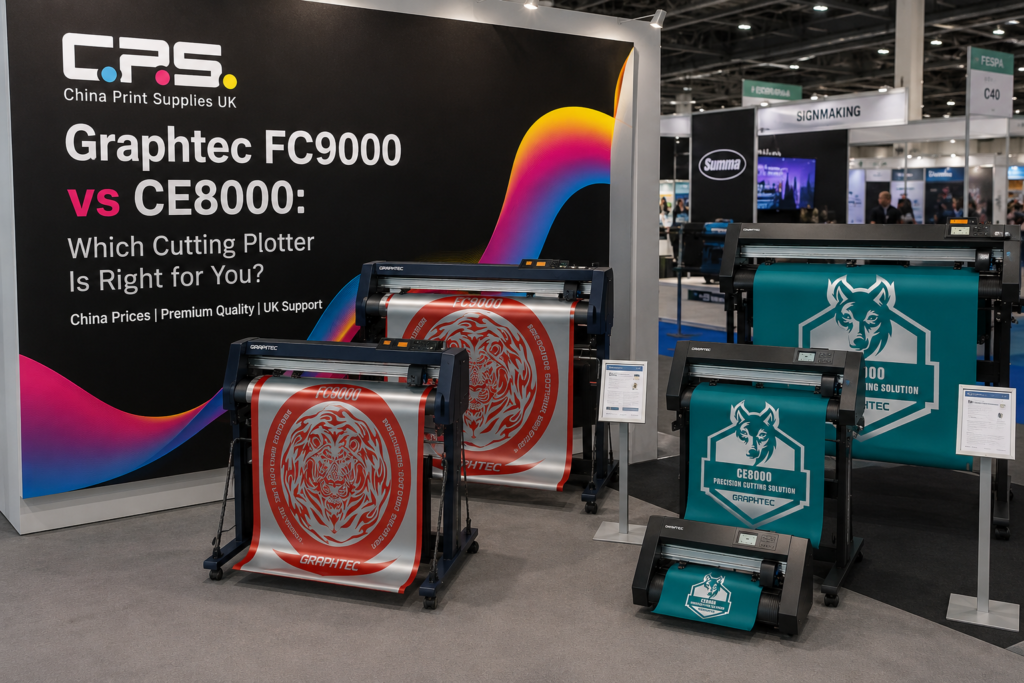
If you’re shopping for a new Graphtec cutting plotter, you’ve almost certainly narrowed your search down to two names: the Graphtec FC9000 and the Graphtec CE8000. Both are current-generation machines from one of the most trusted names in vinyl and print-and-cut technology, and both are capable of excellent results. But they’re built for different jobs, different budgets, and different production volumes.
In this guide, we’ll break down exactly how the FC9000 and CE8000 compare; cutting force, speed, accuracy, connectivity, build quality, and price, so you can work out which plotter actually fits your workflow, rather than just buying whichever one looks more impressive on a spec sheet.
Quick Answer: FC9000 or CE8000?
If you only have thirty seconds, here’s the short version:
- Choose the Graphtec CE8000 if you’re a sign shop, garment decorator, or small-to-medium production business that needs reliable, professional-grade cutting on vinyl, HTV, and card without paying for industrial-level extras you won’t use.
- Choose the Graphtec FC9000 if you’re running high-volume production, cutting tougher materials like reflective film, sandblast rubber, magnetic sheet, or paint protection film, or you need the fastest, most rigid machine Graphtec currently makes.
Graphtec FC9000 vs CE8000: At a Glance
| Feature | Graphtec CE8000 | Graphtec FC9000 |
|---|---|---|
| Positioning | Mid-range professional / hobbyist workhorse | Flagship industrial production plotter |
| Cutting force | Up to 450gf | Up to 600gf |
| Max cutting speed | Up to 1000mm/s (130cm model) | Higher sustained speed, built for continuous production |
| Widths available | 40cm (desktop), 60cm, 130cm | 75cm, 100cm/104cm, 140cm, 160cm |
| ARMS registration system | ARMS 8.0 | ARMS 8.0 with Datalink barcode system |
| Build | Lighter, cost-optimised chassis | Heavier-duty frame, dual-tool configuration option |
| Connectivity | USB, Ethernet, optional Wireless LAN | USB, Ethernet, barcode reader as standard |
| Included stand/basket | Available depending on model | Stand, front and rear media baskets, cross-cutter as standard |
| Best suited to | Signage, HTV, DTF, packaging prototypes, sublimation | Heavy signage production, automotive wrap, reflective, sandblast rubber, apparel patterns |
| Typical buyer | Small-to-medium print shops, home businesses, hobbyists scaling up | High-volume sign shops, vehicle wrap installers, industrial finishers |
What Is the Graphtec CE8000?
The Graphtec CE8000 is the successor to the popular CE7000 and CE6000 ranges, and it’s designed to hit a sweet spot between price and performance. It’s aimed at professional print service providers and lower-volume hobbyists who need dependable cutting without industrial-scale cost.
Key strengths of the CE8000 include:
- 450gf cutting force, which comfortably handles cast and calendared vinyl, HTV, reflective sheet, stencil material, and card up to around 0.25mm.
- ARMS 8.0 registration mark sensing, giving accurate print-and-cut results on holographic, metallic, glitter and high-intensity reflective media.
- A new touch panel with mechanical keys, allowing “blind touch” operation so operators can keep their eyes on the media while it feeds.
- Optional Wireless LAN, plus standard USB and Ethernet, so the plotter can slot into an existing network without extra cabling.
- Three widths – 40cm desktop, 60cm, and 130cm, so you can match the machine to your available floor space and typical job size.
Graphtec markets the CE8000 around enhanced rigidity compared with its CE7000 predecessor, along with a Media Set Assist function that uses suction to keep media from lifting or shifting during feeding. For most sign shops, apparel decorators, and packaging prototypes, this is more than enough machine.
What Is the Graphtec FC9000?
The Graphtec FC9000 sits above the CE range as Graphtec’s flagship roll-fed cutting plotter. It’s built for shops that live and die by uptime and precision at volume; vehicle wrap installers, large-format sign producers, and apparel pattern cutters who can’t afford registration drift or a machine that struggles with thick or awkward material.
What sets the FC9000 apart:
- Up to 600gf cutting force, noticeably higher than the CE8000, which makes a real difference when cutting magnetic sheet, rubber sandblast stencil, and high-intensity reflective film.
- A re-engineered feeding system and cutting head, giving more consistent results across both delicate window tint film and thick, rigid materials.
- Standard barcode reader (Datalink), allowing the plotter to automatically pull cutting data and settings linked to a barcode from USB or PC, a genuine time-saver on continuous production runs.
- Comes standard with a matching stand, front and rear media catch baskets, and a built-in cross-cutter, whereas some of this is optional on the CE range.
- Wider size range, from 75cm right up to 160cm, giving production shops more flexibility for large-format work.
- Dual-tool configuration options on certain models, useful for shops running mixed jobs without constant tool changes.
The trade-off is straightforward: the FC9000 costs more, takes up more floor space at the larger widths, and is more machine than a low-volume operation typically needs.
Cutting Force and Material Compatibility
This is usually the deciding factor for buyers who already know roughly what they’ll be cutting day to day.
The CE8000’s 450gf is plenty for the vast majority of everyday sign and garment work: adhesive vinyl, HTV, cardstock, paper, and most reflective sheet. Where shops start to hit its ceiling is with thicker or tougher materials; heavier magnetic sheet, thick rubber stencil for sandblasting, or paint protection film that needs a deeper, more consistent cut.
That’s exactly where the FC9000’s 600gf and re-engineered feed system earn their keep. If your job list regularly includes sandblast rubber stencils, magnetic media, or PPF, the extra force isn’t a luxury, it’s what stops you from running multiple passes or replacing blades more often than you should.
Accuracy and Registration: ARMS on Both Machines
Both plotters use Graphtec’s ARMS (Advanced Registration Mark Sensing) technology, so print-and-cut accuracy on printed graphics is strong on either machine. The core difference is what surrounds that accuracy at scale.
The FC9000’s standard Datalink barcode system means an operator can queue up a stack of pre-printed jobs, each carrying its own barcode, and let the plotter identify, load, and cut each one automatically in sequence, without a computer connection running the whole time. For a shop cutting dozens of jobs a day, this removes a meaningful chunk of manual handling.
On the CE8000, the same barcode-linked continuous cutting is available, but the overall package is positioned around simpler, lower-volume workflows rather than unattended, high-throughput runs.
Speed and Production Throughput
Both machines are fast by industry standards, with the CE8000’s 130cm model rated up to 1000mm/s. But rated top speed on a spec sheet only tells part of the story, what matters in a busy shop is sustained speed under load, on thicker media, without registration drift.
This is where the FC9000’s heavier-duty frame and dual-tool capability show their value. It’s built to run flat-out for longer periods on tougher jobs, which is precisely the scenario where a lighter, cost-optimised chassis like the CE8000’s is more likely to show its limits.
If your throughput is moderate, a handful of jobs a day, mostly vinyl and HTV, you’re unlikely to notice a meaningful difference. If you’re running an FC9000-style production schedule with back-to-back jobs across mixed materials, the CE8000 will start to feel like it’s working harder than it should.
Size Options: Matching the Machine to Your Shop
One of the easiest ways to narrow your decision is simply floor space and typical job width.
- CE8000: 40cm desktop, 60cm, and 130cm. The 40cm desktop model in particular suits home-based businesses, small studios, and anyone without a dedicated production floor.
- FC9000: available from 75cm up to 160cm. There’s no small desktop version, this range assumes you’re already running a production floor with roll media storage and space for a full stand-mounted machine.
If you’re regularly cutting full-width vinyl rolls (54″ and above) for vehicle graphics or large signage, the FC9000’s wider format options are the more natural fit. If most of your work is smaller-format signage, decals, or garment transfers, the CE8000’s size range is more proportionate to the job.
Software and Connectivity
Both plotters ship with Graphtec’s standard software bundle, Graphtec Studio (or Graphtec Pro Studio on the FC9000) for standalone design and cutting, plus the Cutting Master plug-in for driving the plotter directly from Adobe Illustrator or CorelDRAW. Both support USB and Ethernet.
The CE8000 offers Wireless LAN as an option, useful for shops that want to avoid running an Ethernet cable to the plotter’s location. The FC9000 is positioned as network-ready as standard, in keeping with its role as a production-floor machine that’s likely to be permanently wired into a shop’s workflow.
Price and Value
As you’d expect from the specification gap, the CE8000 is the more affordable machine across every comparable width, making it the natural entry point for shops moving up from an older CE6000/CE7000 or a lower-end competitor cutter. The FC9000 carries a higher price across its range, reflecting its heavier build, higher cutting force, standard accessories (stand, baskets, cross-cutter), and production-grade positioning.
The right way to think about the price gap isn’t “which is cheaper” but “which machine costs you less over time.” A CE8000 bought for a job load that regularly maxes out its cutting force will cost you in blade wear, re-runs, and downtime. An FC9000 bought for light, occasional vinyl work is simply more machine, and more cost, than the job requires.
Who Should Buy the Graphtec CE8000?
- Small-to-medium sign shops and print service providers
- Garment decorators cutting HTV and DTF transfers
- Home-based businesses and hobbyists scaling into paid work
- Shops mainly cutting vinyl, card, and standard reflective media
- Buyers prioritising value without giving up professional ARMS accuracy
Who Should Buy the Graphtec FC9000?
- High-volume sign and graphics production shops
- Vehicle wrap and paint protection film installers
- Businesses regularly cutting sandblast rubber stencil or magnetic sheet
- Apparel pattern cutters needing consistent, heavy-duty output
- Shops running continuous, barcode-driven production queues
- Anyone who needs the widest available cutting widths (up to 160cm)
Final Verdict
There’s no universally “better” machine here, only the machine that’s better for your workload. The Graphtec CE8000 is a genuinely capable, well-priced plotter that will comfortably handle the everyday cutting needs of most sign shops, garment decorators, and growing small businesses. The Graphtec FC9000 is built for the shops that have outgrown that category, where cutting force, sustained speed, and production automation directly affect how much work gets through the door each day.
If you’re still unsure which model and width suits your specific materials and job volume, our team at China Print Supplies can talk you through the options and help you match the right Graphtec plotter to your production needs.
Frequently Asked Questions
Is the Graphtec FC9000 worth the extra cost over the CE8000?
If you regularly cut thicker or tougher materials; magnetic sheet, sandblast rubber, reflective film, or run high job volumes, yes. For lighter vinyl and HTV work, the CE8000 delivers comparable accuracy for less outlay.
Can the CE8000 handle print-and-cut jobs as accurately as the FC9000?
Both use Graphtec’s ARMS registration system, so print-and-cut accuracy is strong on either machine. The FC9000’s advantage is more about sustained production throughput and cutting force than base registration accuracy.
What’s the smallest Graphtec plotter in either range?
The CE8000-40 is the smallest, a 40cm desktop model well suited to home studios and small businesses. The FC9000 range starts at 75cm and is designed for production-floor use.
Do both plotters support barcode-driven continuous cutting?
Yes, both support Graphtec’s Datalink barcode system for continuous cutting, though it comes as a standard, production-oriented feature on the FC9000.